
Ohio....Time To Unify
Let's Not Squander Our Best Opportunity in Decades

I don’t know about you, Ohio.
As bad as things are, I will do anything in my power to end gerrymandering, put a stop to all the “pay to play” and trickle-down policies that are taking Ohio in the wrong direction, and keep Vivek Ramaswamy from becoming our Governor.
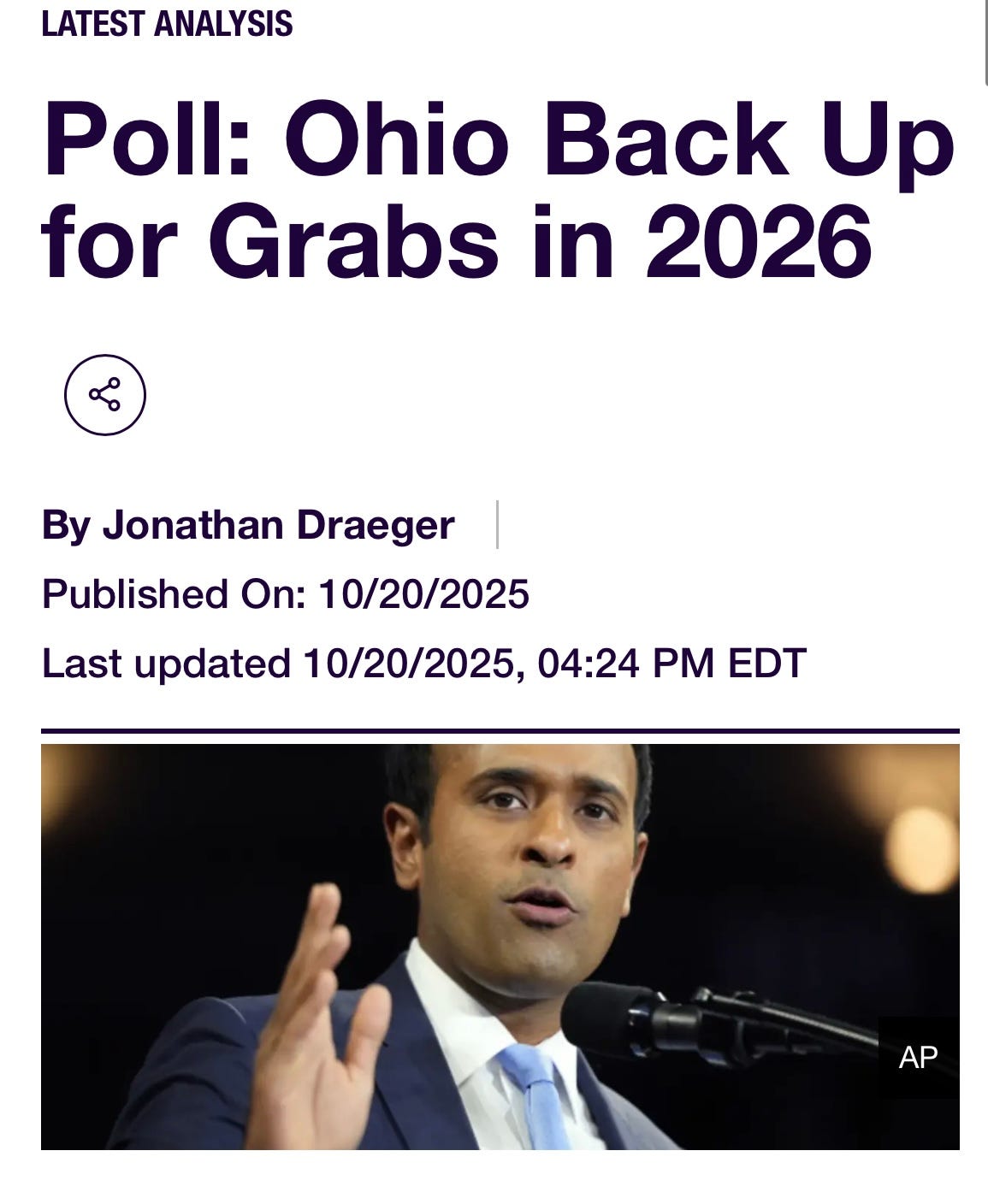
Which is why I’ve been so excited to help Dr. Amy Acton as she runs for Governor against Ramaswamy. And recent polls make it very clear that there is a path to victory:
Why Amy Acton?
Why do I place such high hopes in Dr. Amy Acton as a candidate?
Because I learned, both as a candidate and as a party chair, that the hardest thing about running statewide in Ohio is getting known…everywhere.
Ohio is a huge state. So many communities. So many media markets. So many people.
Even after years on the scene and millions spent on their behalf, even long-time politicians struggle to break into the minds of most Ohioans.
But after displaying her unique brand of leadership as Ohio’s health director, Amy Acton IS known. Everywhere.
But even harder than getting known is getting known and respected in a non-political and non-partisan way. It’s incredibly rare that the first impression a public figure leaves is not as a politician, but someone who gains respect for reasons that rise above politics.
The way John Glenn did.
Well, that’s what Dr. Amy Acton managed to achieve at a time where millions were paying attention. Ohioans saw her as a doctor and public servant trying to save lives—working across the aisle to do it—as opposed to a politician playing politics. And she skyrocketed in their estimation because of that.
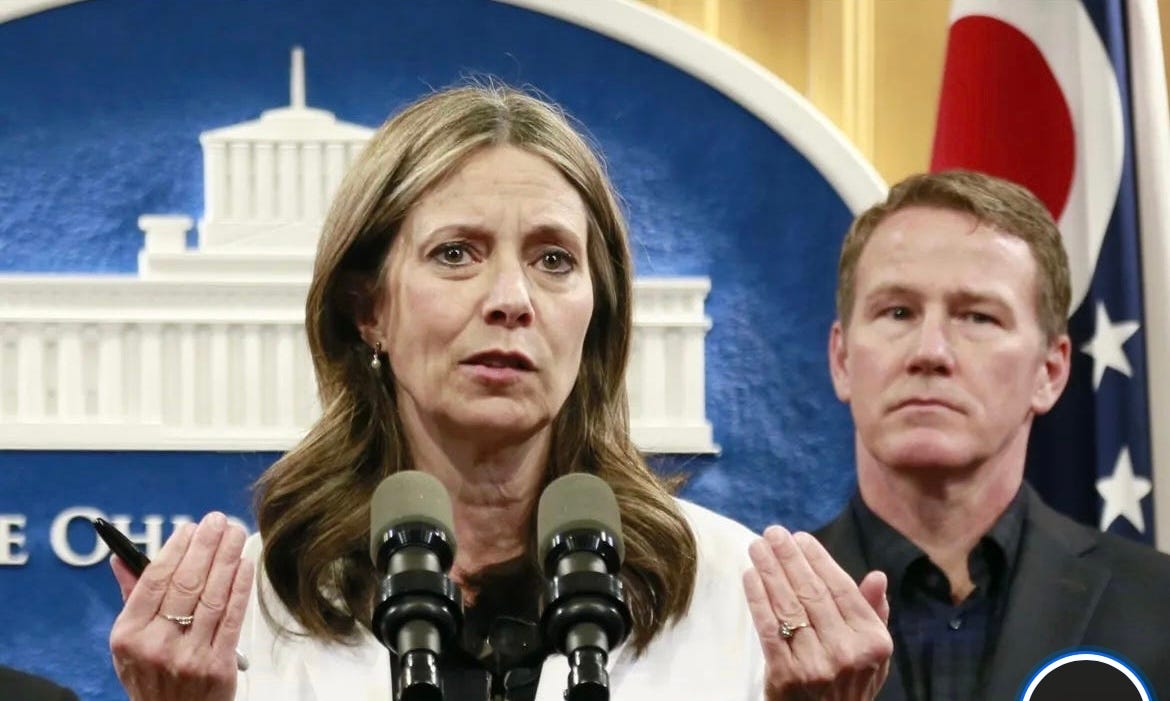
So my instinct has always been that her unique entree onto the scene in Ohio placed Dr. Acton in a once-in-a-generation position, which is why when she expressed interest in serving Ohio again, my response was: what a rare opportunity to change the direction of a state whose politics are badly broken and only getting worse….
So, that was my instinct.
Well, here’s the good news….
Polling Confirms It…
Polling confirms that that instinct was correct.
A few weeks back, I shared the data that of all public figures in Ohio, Amy Acton has the highest job approval (for her work as health director) in the state of Ohio. Her work was approved by +10, more than twice any other figure tested. (And that was in a Trump +13 universe).
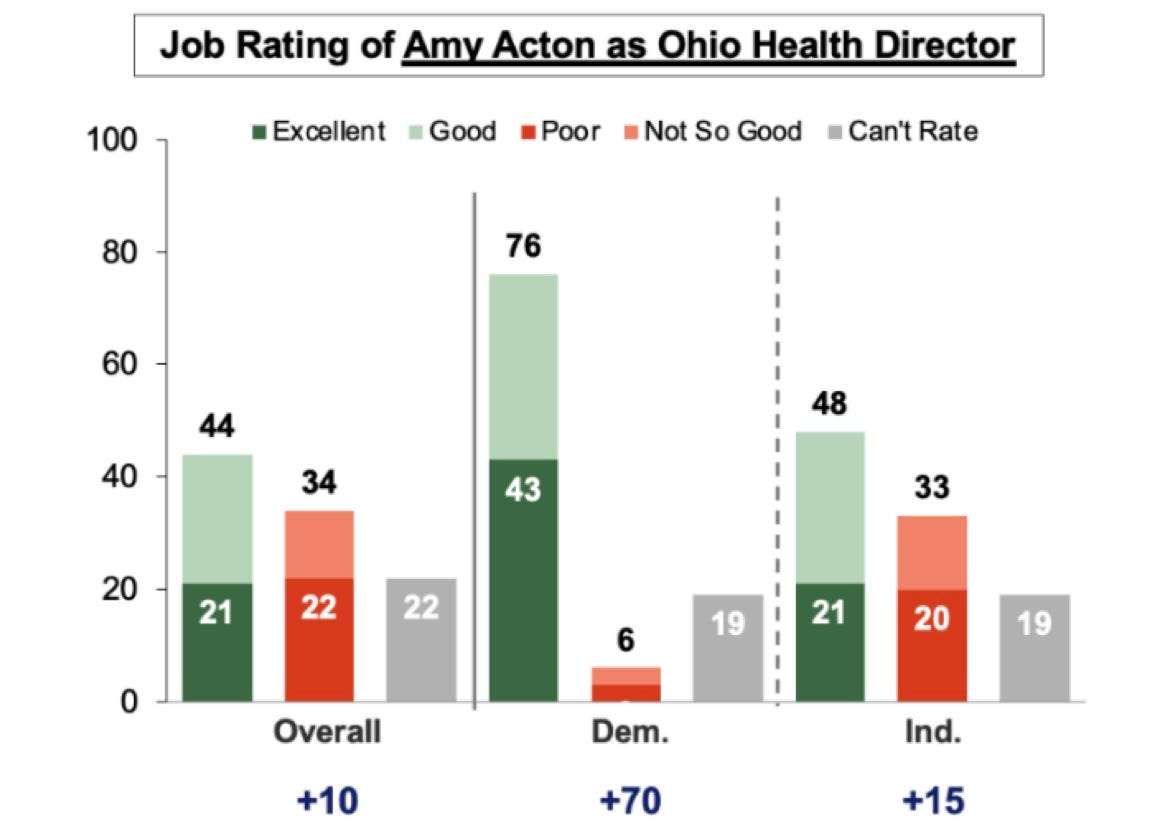
She enjoyed overwhelming support from Democrats, strong support (+15) from Independents, and even a good amount of high marks from Republicans.
As I said, it is rare that a figure makes such a dramatic, respected and non-partisan entree across a state this big—leaping past almost every other public figure in the state after only a few months on the scene.
And this striking data was only confirmed by another poll (conducted by Bowling Green State University—BGSU) last week. When asked about a variety of public figures, Dr. Acton once again scored the highest of any Ohio public figure — at +5 net approval (in a poll that voted for Trump by 10). Again more than double anyone else, while most (including Vivek Ramaswamy) were underwater (-4).
And remember: all of this comes years after she was last on our TV every day, and it comes without any campaign dollars being spent on her behalf. Yet still, so much good will remains for her as a public servant and leader, and now as a candidate for Governor.
First impressions are key to politics. And she has made a uniquely strong first impression—and even with years gone by, it is lasting.
A rare opportunity indeed.
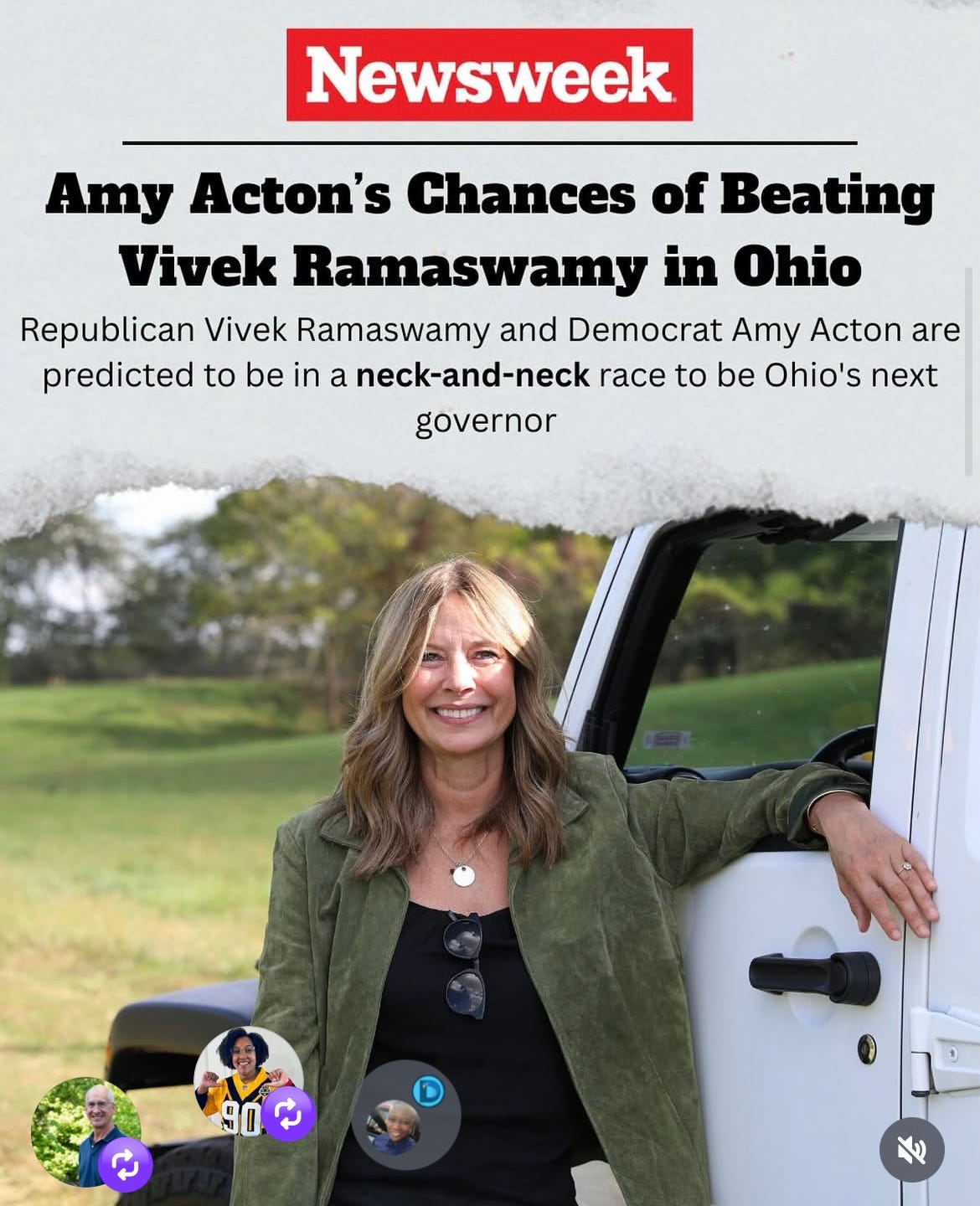
Acton vs. Vivek: All Tied Up
Now, compared to Dr. Acton’s very positive first impression, Vivek Ramaswamy has managed to achieve the opposite.
Polling already shows that he may be the most toxic candidate at this point of a Governor’s race we’ve ever seen.
His negatives in some polls are in the high 30s to low 40s.
That’s actually very difficult to achieve—as I said, it’s hard to get known across Ohio. That level of negativity usually only happens when an opponent spends $100s of millions attacking you.
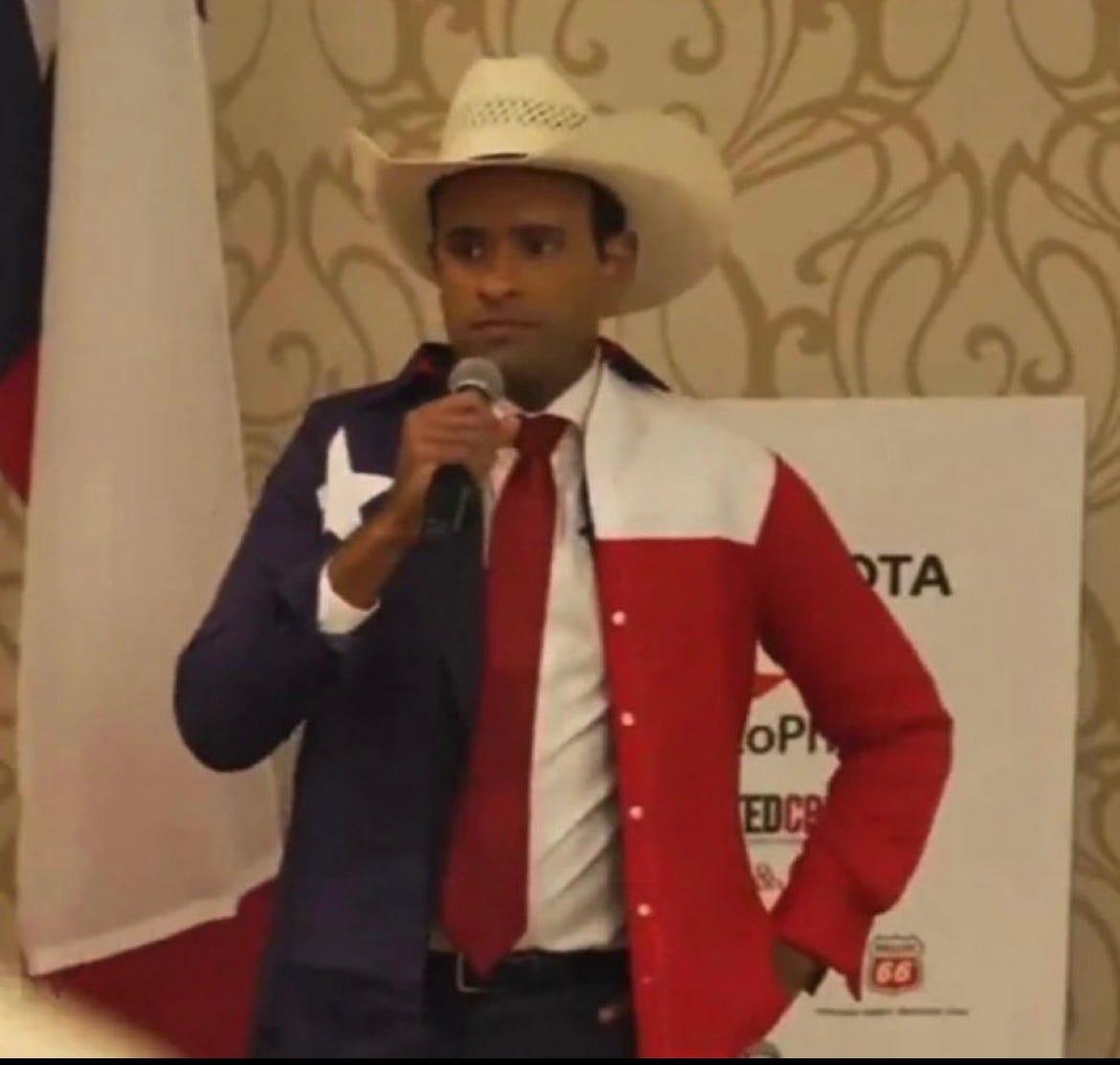
But in this case, Vivek has managed to run up those negatives all on his own—from the presidential primary to his FOX News appearances to his tweets to banning unions he doesn’t like to whatever else he’s doing via that fancy jet of his, he’s managed to present himself to Ohioans in a way that is turning them off at strikingly high levels:
We see this again in the BGSU poll—while Dr. Acton’s net approval is +5, Vivek has a net disapproval of -4.
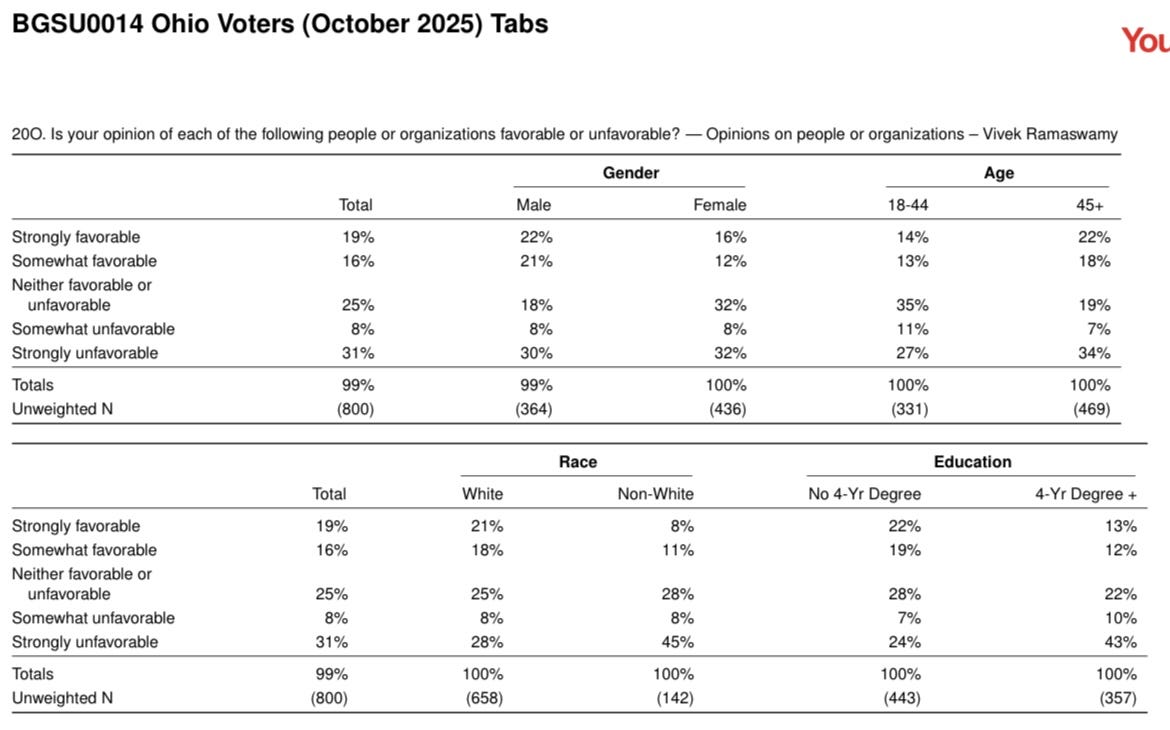
Perhaps most striking….with independents, Ramaswamy is deeply underwater at -21: 21 positive, 42 negative!
So what happens when you have a match-up between the public figure with the highest job approval rating in the state and the person who’s negatives are sky high — well, as you’d expect, it’s already a real race, even in conservative samples:
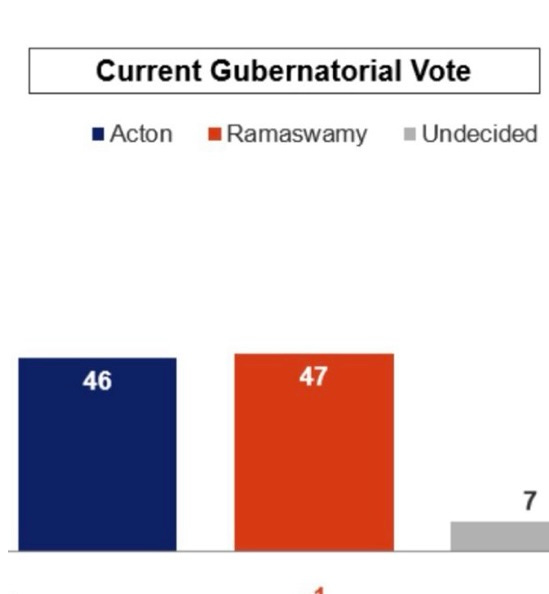
Which is why, except for one outlier poll (which had a sample more conservative than the 2024 electorate), Amy Acton has been consistently in the margin of error, tied, or even ahead in the polls that have been done on the Governor’s race.
Why?
Well, for all the reasons above, and because she consistently leads Vivek with independents, and picks up some Republican votes as well.
In various polls, she’s led independents by between 8 and 12 points. And in that new BGSU poll, she leads with independents by a whopping 54-35!
19 points!
That, my friends, is how you win Ohio.
So….Let’s Not Blow It…
So that’s the good news. Hard data that confirms that all the naysaying and defeatism in Ohio is not only off-base, but self-defeating.
Bottom line: we have a match-up between a political outsider who has the highest job approval and net favorability ratings in Ohio, against a truly toxic candidate who is out of touch with everyday Ohioans. And we have it in a year (a mid-term of a second-term, unpopular president) that history suggests will be full of opportunity.
When you have an opportunity this rare come your way, let me offer a simple suggestion:
Don’t.
Blow.
It.
And yes, this immense opportunity can be blown in any number of ways,
One way is defeatism—convincing ourselves we just can’t win in spite of all the clear data above showing us that we can. Such defeatism will be self-fulfilling if it continues.
And a second way to blow it is…
…a last-minute primary challenge to this once-in-a-generation candidate who is viewed above the morass of partisan politics.
While in some circumstances a primary can be helpful, or perhaps neutral, let me walk through all the reasons why a primary here—this late in the cycle against a candidate who has a strong appeal in part because she’s less political—risks sabotaging this unique opportunity:
1. Amy Acton Leads a Hypothetical Primary….Decisively
While Amy Acton is respected in a non-partisan way, Democratic voters are especially impressed by her work. And that explains why in every hypothetical primary matchup thus far against Tim Ryan (the candidate mentioned as her hypothetical opponent), she has led.
Decisively.
In the most recent poll (BGSU), Acton leads Ryan by 9 points.
In a prior poll, she led the primary by 14 points.
In the recent BGSU poll, her net favorability with Democrats is +40; Ryan’s net favorability is +19.
She leads with women 54%-38%.
She leads with “non-White” voters 52%-39%
While Acton’s net approval with all voters stands at +5 in the BGSU poll, Ryan’s stands at -2.
And again, she leads this decisively despite the fact that Ryan ran a full, deeply funded statewide campaign for US Senate not long ago—while Acton has never run for an office since student council, has never had a dollar spent to present her to the state, and last appeared on TV regularly in 2020.
She’s positioned this strongly mainly on the positive impression she created five years ago, and the grassroots support that has organically gravitated to her campaign thus far.
Bottom line: the polling is clear that she would win the primary, and that the Democratic base—women and voters of color—in particular strongly supports her.
But what happens when someone enters a primary late and this far behind?
They know the only way they can win that primary is to go negative against the opponent who leads them. Which means the most likely result of a late primary here would be that Amy Acton wins the primary, but endures six months of attacks by someone who enters late and trails her badly.
And that leaves Amy Acton with only one choice—to respond in kind.
So a doctor who is currently so revered by Ohioans because she’s viewed as above party gets thrown into a negative primary where she’s forced to be intensely political herself.
To say the least, that does not help us defeat Vivek Ramaswamy. It helps him immensely, and explains why he’s openly excited about the prospect of this happening.
2. Amy Acton Does Better with Independents
One key to victory in Ohio is how you fare with independents. And in the recent BGSU poll, it’s not even close.
As I wrote above, Acton leads with independents 54-35. That’s the path to victory in a general election.
In the same poll, Acton’s net favorability with Independents is +10; Ryan’s net favorability with independents is -9.
In a general election, that’s a huge difference. The candidate who does better with independents is generally the far stronger general election candidate.
3. But What About COVID?
One justification for a primary is the suggestion/assumption/myth that because Dr. Acton saved lives during COVID, that this somehow will be a weakness in the general election. “We don’t need to relive that,” people say.
Ask Andy Beshear or Gretchen Whitmer—or Mike DeWine—how that debate turned out? They each did better.
But you don’t even have to ask them.
Because recent polling also makes clear that Democrats convincing themselves (or trying to convince others) that COVID is an Achilles heel are dramatically misreading the Ohio electorate, and the mood entering the midterm.
First, Acton’s job approval rating as health director would not be at +10 if COVID was such a weakness. Those who don’t like her bipartisan work during COVID know who they are, and they’re already factored into that equation. And she still is at +10. Her detractors may be loud, but they’re not a huge number, and they’re highly unlikely to vote for any Democrat.
And when a pollster simulated attacks against Dr. Acton (parroting what we know Vivek will say about COVID), it turns out that COVID is the weakest attack against her. And that’s because: 1) it’s a complicated issue with lots of cross pressures (seniors in particular supported her response to COVID), 2) people’s general impression is that she led well, and 3) it’s an issue from years ago versus issues today where an outsider/doctor trying to help lower costs, expand health care access and solve other problems may be exactly what people are looking for.
This will only be more the case as RFK and others recklessly create conditions where measles and other outbreaks are already happening. Just as in 2020, a trusted doctor will be something voters embrace versus the chaos and danger of DC and reckless state politicians (have I mentioned that Ramaswamy has yet to comment on whether he agrees with Florida’s decision to stop immunizations?)
4. The Real Attacks? The Usual Ones
If COVID is the weakest attack, what are the far more effective attacks?

No surprise…they are the more traditional partisan attacks the GOP will wage against any Democratic candidate. You’ve heard it all before—“tax and spend” liberal moniker, the border, the culture wars, crime, and the things we hear every election. And polling shows those are the types of attacks (levied against all Democrats) that are far more effective than trying to attack Acton on the topic where she stands at +10.
And do you know what that means?
It means that the last thing you want to do is replace a less partisan/political candidate currently tied in the polls and substitute in her place a traditional and long-term Democratic/DC politician. Because the more effective, traditional attacks are far more likely to “stick” against that long-time DC politician than they will with the outsider who has not been part of politics. And especially when a politician has a long record, they will be able to find and attack the very positions that line up with their most effective attacks.
For example, you’ll see ads like this pop up:
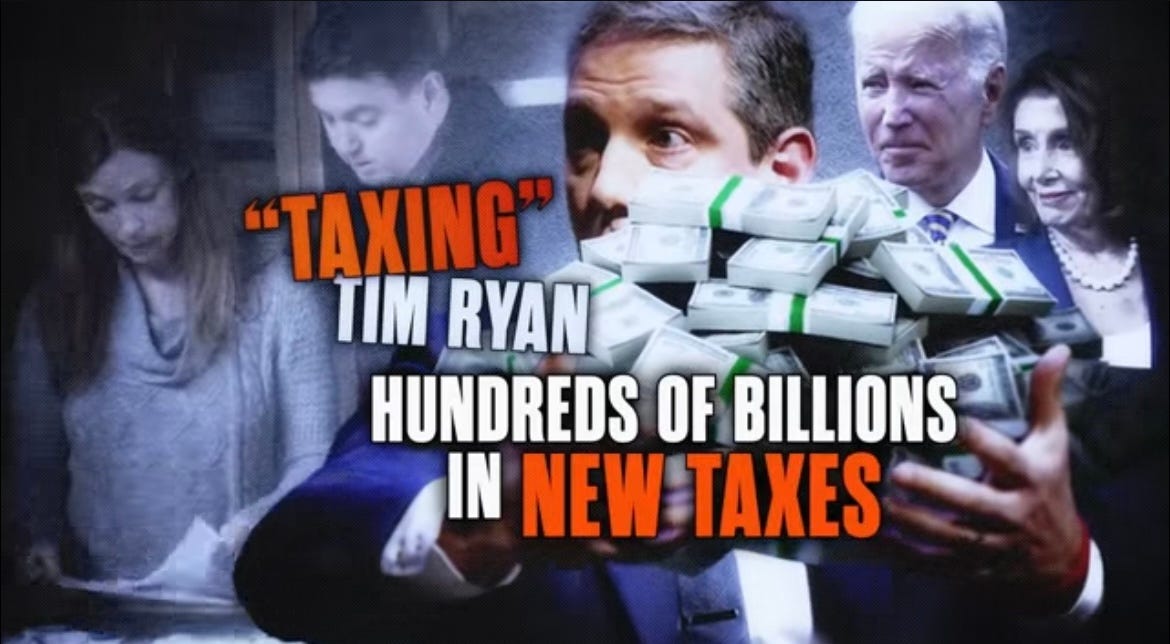
And you’ll see the same attacks they ran so brutally against Kamala Harris all fall make a return, citing right-wing articles like this one.
We’ve seen this movie before, and we know how it ends.
In other words, Amy Acton’s nonpolitical “brand” is better than the current Democratic brand, and it’s a better brand than long-time Democratic politicians—especially in the back and forth of an actual campaign.
Of course we have to fix that party brand, and we have a lot of work to do. But why would you replace the better brand with the brand that is more vulnerable to the GOP’s strongest attacks?
And attacks against Acton for her life’s work turn out to be far less effective than attacks against a long-time Democratic politician with a long DC record.
So why would you replace her with someone who has a far longer partisan record susceptible to those more effective attacks? Especially when the best contrast for a Republican candidate like Vivek (who wants to be seen as an outsider) is against the DC/political insider brand.
Data back this up too:
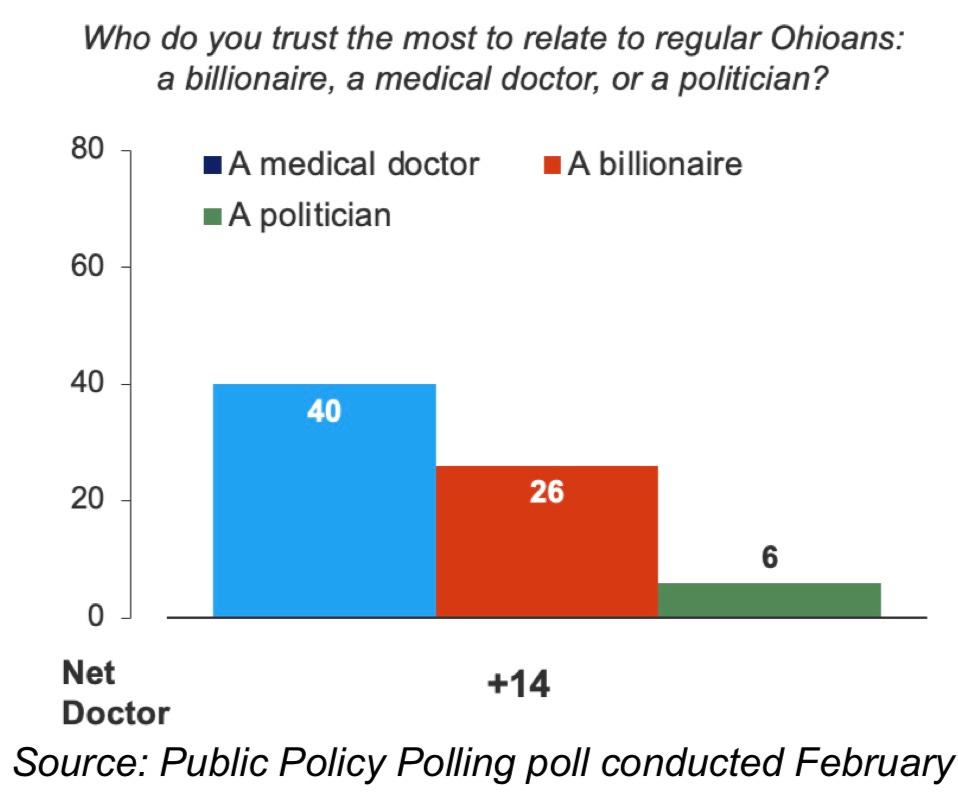
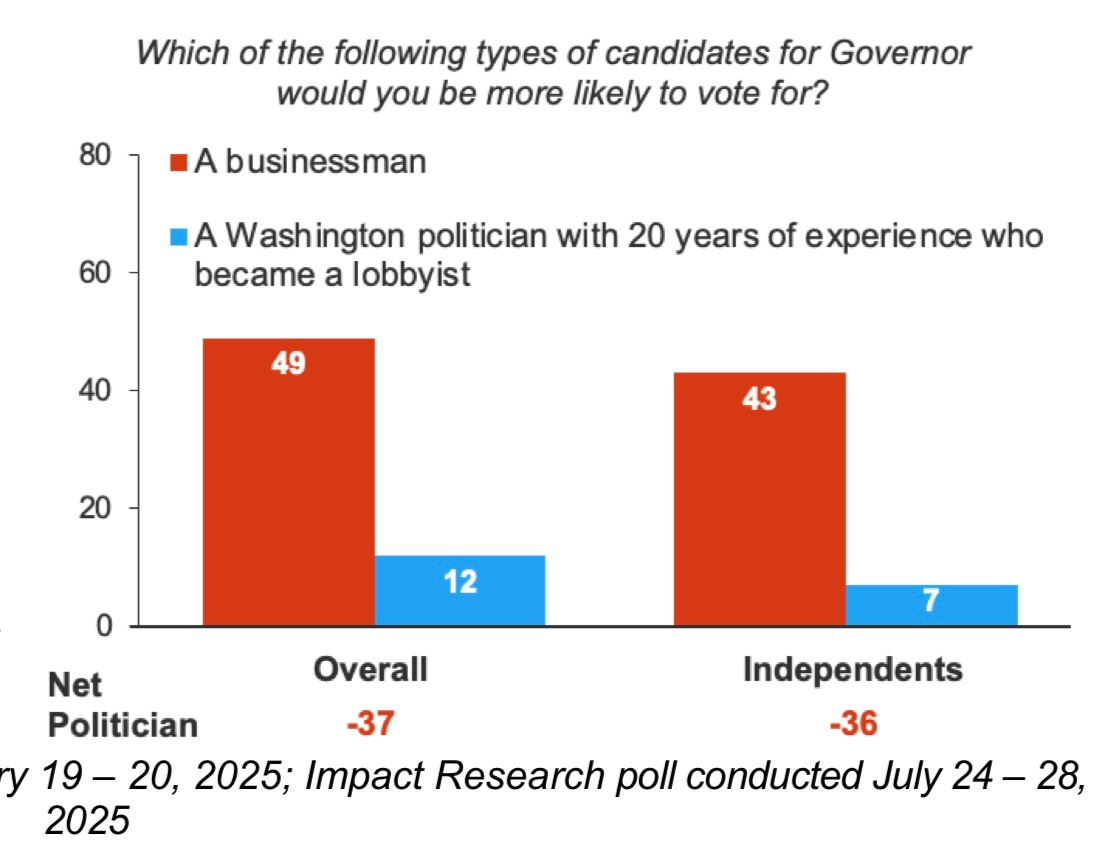
You would never want to do that, would you?
Not if you wanted to win.
4. Money, or Lack Thereof
Vivek may be a highly problematic candidate.
He may have sky-high negatives.
He may have no business being anywhere near the Governor’s office as he schemes his way to being president.
But he does have one thing…a lot of money.
And that’s why a contested Democratic primary against Acton, the public figure with the highest job approval rating in Ohio, would also be damaging.
You don’t need to keep up with Ramaswamy’ millions to win the election. But you do need to raise millions to get your message out.
Now the good news is that Amy Acton is setting records for a non-incumbent Democratic Governor candidate. Both in terms of the amount she’s raising, and in terms of the tens of thousands of individual contributions she’s already garnered. And all that is even more striking for a first-time candidate starting from nothing. And it’s only growing, and that’s how you beat a billionaire (as Susan Crawford showed in Wisconsin).
But what happens with a primary?
First, many people don’t give at all. They don’t want their money spent against other Democrats, so they wait until the primary is over to start giving. This is true in-state, and this is true nationally (“we’ll wait for Ohio Democrats to figure it out before we send any money there”). And it’s true with major supporters like labor unions.
And when early money is so important to gain even more later money, donors sitting on the sideline for six months of a two-year cycle does incredible damage. All while Vivek is raising money into his war-chest every single day.
Second, rather than building your own warchest, you’re stuck spending through that warchest just to win the primary. The money is being spent, which is bad enough—but worse, it’s not being spent against Vivek Ramaswamy. He gets a six month pass while two Democrats blow through precious Democratic dollars attacking one another—likely ending the primary with an empty warchest while both candidates are tainted.
5. Vivek Faces No Primary
There will be no real primary on the GOP side of the aisle. The state party is already all-in for their toxic candidate, helping him in every way possible.
In the meantime, a contested primary on the Democratic side sidelines the party (which would and should remain neutral) from being an advocate and open supporter of the public figure with the highest job approval in Ohio. Instead, the party becomes a referee between two candidates attacking each other.
This essentially gives the GOP a six-month head start for the general election: they are all in advocating, while the Democratic Party is trapped in referee mode all that time, its hands tied behind its back in too many ways.
6. That’s the Ticket
Remember, this is about a ticket, and not just one race.
A good ticket complements one another—when it comes to the candidates, turnout, message, and everything else. A good ticket spans wider and deeper than each candidate on his or her own.
Sherrod Brown is running as the Democratic candidate for Senator, and he has spent his life fighting for workers.
Acton brings a new and wholly different resume and brand, with a different appeal and the highest net favorability among women.
Together, these two complement each other well. They provide a good balance. They appeal to different parts of the electorate in different ways. They reinforce one another, but also cast a wider net than each would by themselves.
Removing Acton from the ticket and replacing her with someone who’s served in Congress for a long time, lost in 2022, and who is underwater with independents, narrows the ticket rather than adds to it.
The balance disappears. The essential element of new and fresh, not to mention Democrats (a party being driven by women’s activism) having a woman as one of the two leaders of their ticket, disappears.
Voters simply see the same people they’ve seen doing this for years doing it again.
Same brand, no changes.
The ticket is far weaker because of that.
No more complement.
7. A Two-Year Cycle: Doing the Work
The first piece of advice I give anyone contemplating running for office is simple: start early.
Whether its getting out to communities or counties, building a grassroots network, honing your skills as a candidate, listening, or fundraising, starting early is the key to it all.
That is especially true for a statewide campaign, and especially true for Governor—where you aren’t just running to win, but you’re running to govern, and so much of the work you need to do to govern effectively actually takes place during the campaign. Every month of a campaign is an opportunity to build; every month that goes by when you aren’t running is simply squandered time and opportunity. You can’t make up for that lost time.
A statewide race is at least a two-year cycle. Every month that passes when you’re not campaigning spells lost opportunity. An entire year passing, exponentially worse.
Amy Acton was considering running through much of 2024, traveled all over, and she formally began running in January. That is how you run for Governor. It’s how you build a robust campaign, it’s how you ensure you get to know constituencies across this very large state, it’s how you listen deeply, and it’s how you prepare to govern effectively once you win. It’s how you avoid the dilemma we too often create of only showing up late when communities want to be heard and respected early.
Kicking off a two-year race after the entire first year has already passed makes it far harder to do all this, and, ultimately, to win. You’re setting yourself back from the very beginning. You’ve lost invaluable time (a whole year) that you will never get back. Many communities will never see you.
You can still be a spoiler in a primary, of course, but you’ve made it far harder to ultimately win and govern well.
8. The Rest of the Ticket
History could not be more clear—the top of the ticket largely drives the results down-ticket.
And a strong top-of-the-ticket is the best recruiting tool for the entire ticket.
On the other hand, uncertainty at the top of the ticket makes filling out the entire ticket more difficult.
Right now, there are no announced Democratic candidates for State Auditor, State Treasurer, or Ohio Supreme Court. And there is a contested primary for Secretary of State.
These are critical positions…if we want to end gerrymandering, especially. (Yes, if we win the Governor’s race and Auditor or Secretary of State, we can end gerrymandering).
And the best news is how weak the GOP candidates in these spots are. Sprague? LaRose? Faber? Believe me, this is not an impressive group.
But it’s late, and time is ticking.
The party’s top focus (and I know our new chair is working hard on this) should be to fill out the rest of the ticket with strong candidates. A ticket of Brown-Acton, in the midterm of an unpopular GOP presidency, should make this a year where top-flight candidates want to join the ticket and run for these critical posts.
But a messy primary that splits the party while the GOP is united around their candidate could very well convince potential candidates to stay away.
Let’s Go!
I could say a lot more, but I think those eight points provide reason enough to unify and move forward.
Almost a year has passed, and we have one year to go.
It’s time.
We have a once-in-a-generation candidate whose “doctor not a politician” brand is better than her opponent’s and currently stronger than the party she is representing.
She’s positioned incredibly well for that reason.
She’d been putting in the work all year.
She provides a perfect complement to our Senate candidate, making the ticket stronger.
And her support is burgeoning.
She has a decisive lead in the primary, and with strong numbers with independents, a path to victory in the general.
And she’s just getting started.
Let’s not blow this.
And while you’re at it, please help Dr. Acton by supporting her here.
And follow her on Substack here.
Your crystal ball is one I have trusted since your very first political novel predicted the future. And so did the next one. And the next one.
You are doing good work David!!! Keep it up. But did I miss a link to donate to Amy? Also, too long… tighten it up a bit ;-)