
Democracy Academy: The Most Devastating Case You’ve Never Heard Of
How the Supreme Court Crushed All Hope of Democracy in the South

Imagine coming of age able to vote.
Then voting actively for years. Seeing neighbors, friends and family all around you voting as well. And over that time, imagine seeing that your collective votes elected officials of your choosing.
Then imagine all of that disappearing almost overnight…being systematically removed from democracy. And almost everyone you know removed as well—as voters, and as elected officials.
And then never returning to democracy for the rest of your lives.
That tragedy is the story of Black Southern men in the late 1800s (women couldn’t vote yet). A democracy they actively participated in in the early years of their lives—which was protected by both a clear Constitution, the federal government, and even troops—would be dismantled as they aged, never to reemerge for the remainder of their lives, and locking in a brutal system of white supremacy all that time.
What happened to that generation is one of the great tragedies—and cautionary tales—in American history. And it’s one of the parts of American history that too many don’t know—and that too want to censor. (Which is why I am so insistent on teaching it.)
Now, it’s important to note that while they were abandoned by many, this generation did not let democracy go down without waging a strong fight.
And today, I want to focus on a man who, while enduring that nightmare, went to court to try and reverse it all.
His name was Jackson Giles, and to his great credit, Jackson Giles stood strong against the avalanche of suppression across Southern states in the late 19th and earlier 20th centuries. For decades, he mounted a herculean effort, rallying many others along the way.
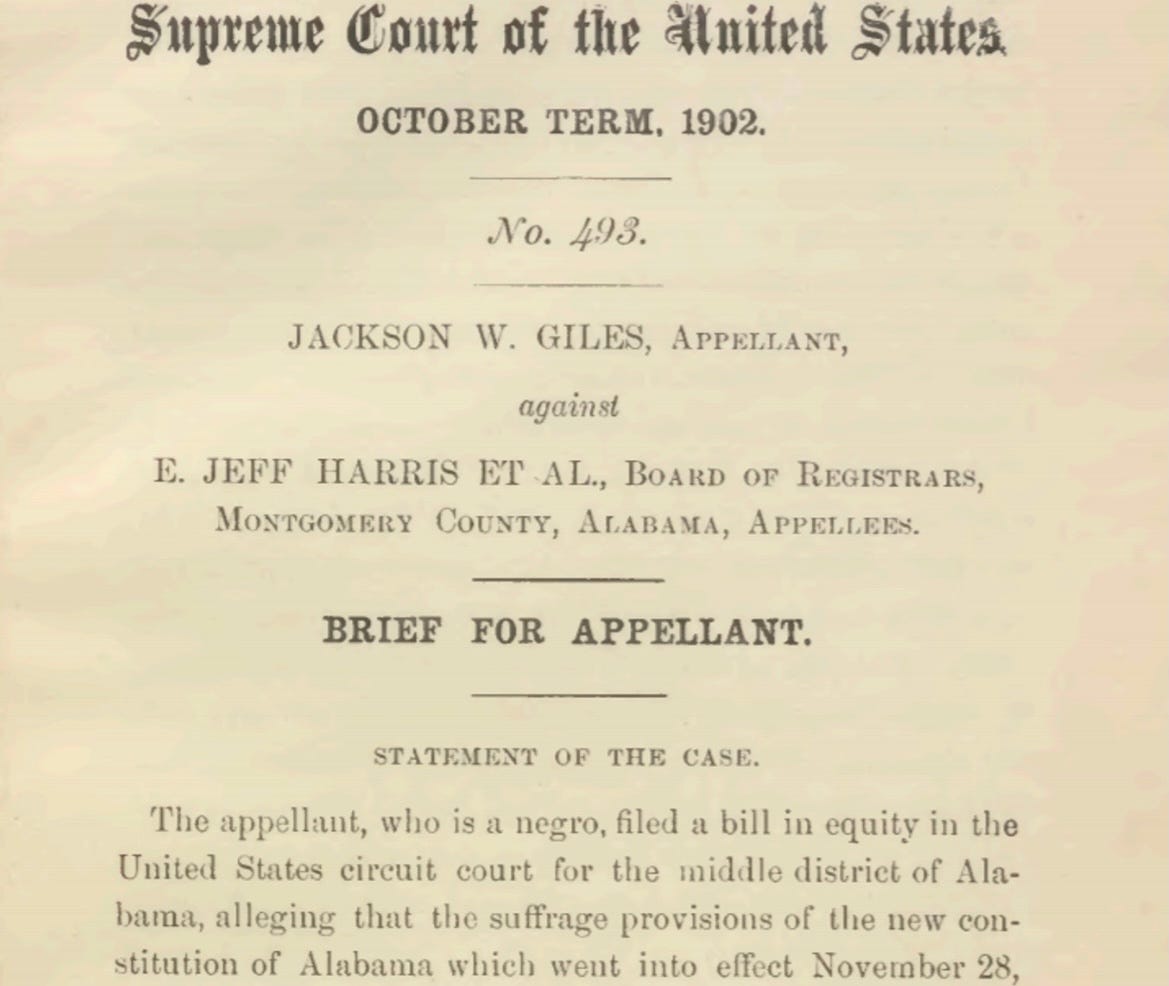
Jackson Giles ultimately brought his fight to the highest court in the land, taking direct aim at an onslaught of suppression tools targeting him and his fellow Black Alabamans. And when he got to the U.S. Supreme Court, he demanded that the Constitutional Amendments enacted in his youth—guaranteeing that his “right” to “vote shall not be denied or abridged by….any State on account of race, color, or previous condition of servitude”—finally be enforced. And he demanded to be reenlisted in the democracy in which he’d participated all of his adult life.
Jackson Giles went all in.
And lost.
It was a Supreme Court decision that cemented into place that tragedy for generations. That for a time, at least, erased all hope that anything could be done. In Alabama, and every other states across the South.
And in a cruel but fitting irony, the defeat was delivered by a man considered one of the great legal minds in the history of American law. That such a towering and celebrated intellect was used to twist Giles’ compelling argument for justice into that devastating defeat tells us everything about how American law (and the Court itself) has operated for too much of the nation’s history.
And the fact that, as Richard Pildes writes, Giles’s case is “probably the most momentous ignored decision in the history of the Supreme Court,” tells us so much about how American history works.
This session of my Democracy Academy focuses on Jackson Giles, the overwhelming suppression of Black voters like him in Alabama and across the South at the turn of the 20th century, and his heroic attempt to reverse it. We will walk through the warped reasoning that led to the devastating outcome—as frustrating as any opinion you’ll ever review.
And as bad as it was, we’ll walk through how recent Court decisions and doctrines still echo the ways in which the Court swept away the final pleas for voting rights and representative democracy more than a century ago.
Standing Up
Jackson Giles was born into slavery on a cotton plantation in Alabama in 1859. Following emancipation, Giles’s family moved to Montgomery. There, his parents—a gardener and a laundress—made sure Jackson and his sisters got an education.
He went on to pursue a wide range of professional paths. At various times, he worked as a grocer, a newspaper publisher, a mail carrier, and a janitor. He also served as a deacon at his church.
But whatever job happened to be paying the bills at the time, the heart of Jackson Giles’ life was as an activist. For democracy. For Black suffrage and participation in the post-Civil War democracy. And for equality, economic justice, and civil rights. And he waged that battle at a time when champions like him were desperately needed. Where fierce resistance was needed.
Because it was a steep uphill battle.
As a young teen, Jackson Giles would’ve seen an Alabama where there were more than 140,000 registered Black voters, on par with the number of registered White voters. And on the strength of that equal participation (Black turnout reached as high as 90% in some elections), the Alabama of his youth elected Black officials at all levels: locally, at the state level (dozens occupied seats in the state legislature), and federally (three members of Congress).
But beginning in 1874, when “Redeemer” Democrats won offices in the wake of backlash and a poor economy, Giles would see it all disappear. The new regime clawed away at voting rights and Black participation in Alabama politics, and that effort was hugely aided by 1) violence and 2) the simultaneous decline of federal enforcement of voting laws and the new Constitutional Amendments.
As an activist, Jackson Giles fought it all. In the 1880s and 1890s, he rose to become a leading member of Republican Party efforts to resist the subversion of democracy in Alabama. And in 1900, he became chairman of the National Negro Race Conference of Montgomery, which took direct aim at the new Southern Constitutions (first in Florida, then in Mississippi) whose aim (expressed directly) was to eliminate Blacks outright from Southern politics.
In 1901, Alabama followed its fellow Southern states, enacting a Constitution whose goal, according to the president of the all-White convention, was “to establish white supremacy in this state.”
And that they did.
The new Alabama Constitution erected a labyrinth of nearly impassable obstacles to voting—criminal disenfranchisement, a literacy test, a cumulative poll tax, residency requirements, a subjective character test—that all but eliminated Black Alabamans from the voting rolls. At the same time, the Constitution “grandfathered in” White voters, shielding them from all these new requirements. As the Supreme Court would later explain: “this part of the constitution, as practically administered and as intended to be administered, let in all whites and kept out a large part, if not all, of the blacks, and those who were let in retained their right to vote after 1903, when tests which might be too severe for many of the whites as well as the blacks went into effect.”
As a result, Black voters were locked out. Compared to the 140,000 registered Black voters of Giles’s youth, and out of more than 180,000 Black men who lived in the state, only 3,000 Black voters remained on the rolls.
And that number no longer included Jackson Giles himself, who had voted for decades. When he applied to vote under the new rules in March 1902, like almost all other long-time Black voters, he was denied.
Even then, Jackson Giles didn’t give up.
